
The AI Product Explosion of 2026: What’s Actually Changing the Industry
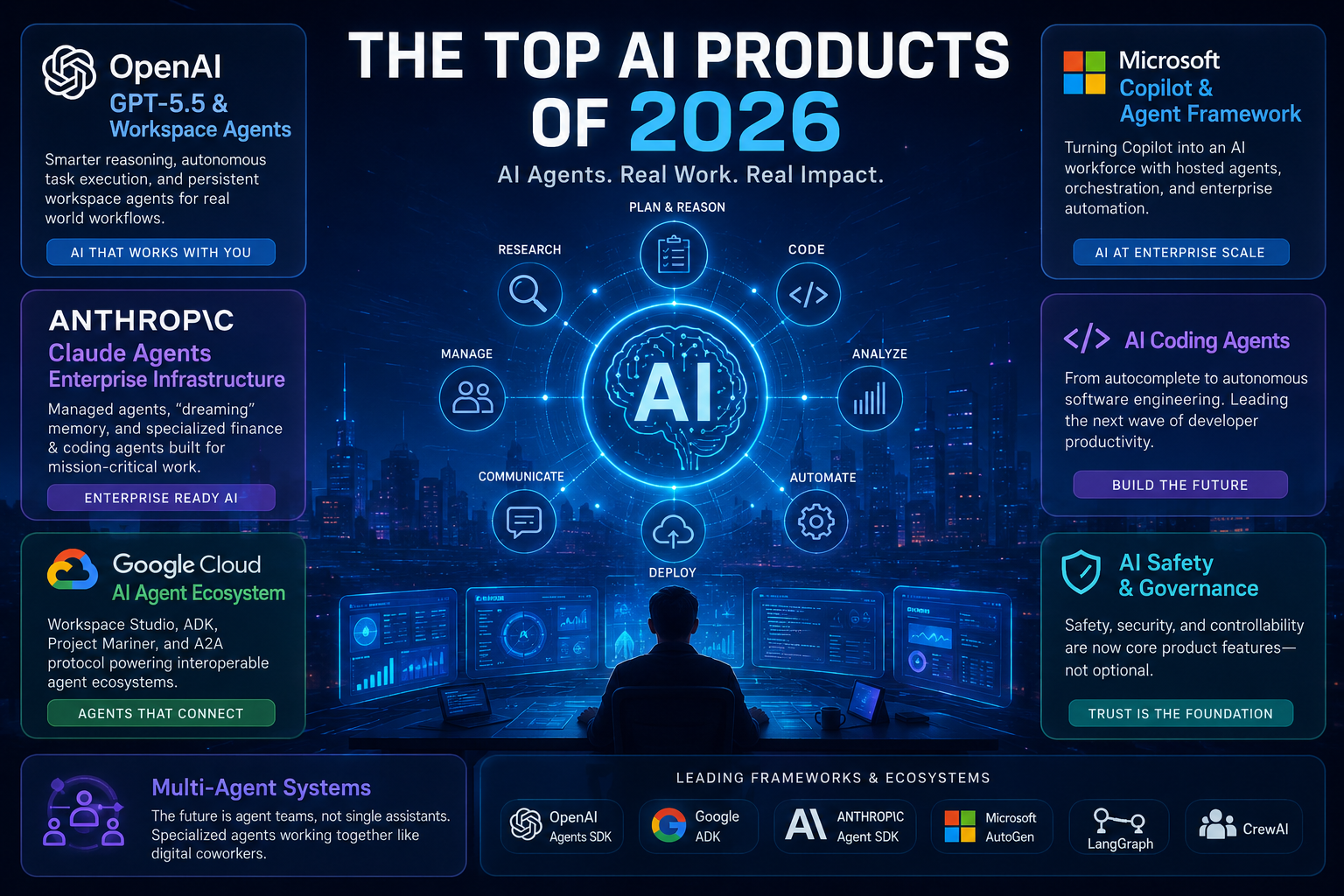
2026 is shaping up to be the year AI stopped being “just chatbots” and became infrastructure. The biggest shift isn’t simply smarter models — it’s the rise of autonomous AI agents, enterprise-grade workflows, multimodal systems, and specialized AI products built for real industries.
The major players — OpenAI, Google DeepMind, Anthropic, Microsoft, and Amazon Web Services — are now competing to own the “AI operating layer” for business, software development, and even government systems.
Here are the most important AI products and trends defining 2026.
1. OpenAI GPT-5.5 and the Rise of Workspace Agents
OpenAI’s release of GPT-5.5 (“Spud”) marks a major leap from conversational AI toward long-running autonomous systems. The company is positioning ChatGPT less like a chatbot and more like a digital coworker capable of handling coding, office tasks, and multi-step workflows. (Axios)
What makes GPT-5.5 significant:
Better long-context reasoning
Stronger autonomous task execution
Native coding and debugging workflows
Persistent memory improvements
Workspace agents integrated into enterprise environments
OpenAI also expanded its ecosystem by bringing Codex and newer models to Amazon Bedrock, signaling a shift away from Azure exclusivity and toward broader enterprise deployment. (Reuters)
The company’s focus in 2026 is clear:
AI agents that complete workflows, not just answer prompts.
2. Anthropic’s Claude Agents Are Becoming Enterprise Infrastructure
Anthropic has aggressively expanded Claude into finance, software engineering, and autonomous workflow automation.
Some of the biggest developments include:
Claude Managed Agents
“Dreaming” memory systems for agents
Financial workflow agents
Claude Code enterprise tooling
Claude Opus 4.7 upgrades
Anthropic introduced a research technique called “dreaming,” allowing AI agents to review prior actions and improve future behavior between sessions. (Business Insider)
The company also launched specialized AI agents for:
Pitchbook generation
Audit reviews
Financial modeling
Credit memo drafting
These are aimed directly at Wall Street and enterprise finance teams. (Axios)
Meanwhile, Claude Opus 4.7 improved coding benchmarks and reduced tool-use errors, making autonomous agents more reliable in production environments. (turion.ai)
Anthropic’s strategy in 2026 is different from OpenAI:
Less consumer focus
More enterprise automation
Heavy emphasis on AI safety and controllability
3. Google’s AI Agent Ecosystem Is Finally Catching Up
After trailing OpenAI in the chatbot race, Google Cloud and Gemini have pivoted hard toward enterprise AI agents.
At Cloud Next 2026, Google launched:
Workspace Studio
Agent Development Kit (ADK)
Project Mariner web-browsing agent
A2A (Agent-to-Agent) protocol upgrades
Managed MCP servers
Expanded Gemini integrations
Google’s biggest innovation may actually be interoperability.
Its Agent-to-Agent (A2A) protocol now reportedly has adoption across more than 150 organizations and major enterprise platforms. (DEV Community)
This matters because the future AI ecosystem likely won’t consist of one giant assistant. Instead, businesses may run fleets of specialized agents communicating with each other.
Google appears to understand this earlier than many competitors.
4. Microsoft Is Turning Copilot Into an AI Workforce
Microsoft Copilot has evolved far beyond document summarisation.
In 2026 Microsoft is building:
Hosted agents
Enterprise orchestration frameworks
AI workflow automation
Multi-agent collaboration systems
The company released Microsoft Agent Framework 1.0 with connectors for:
OpenAI
Anthropic
Gemini
AWS Bedrock
Azure AI
Ollama
Microsoft’s advantage is distribution.
Unlike newer AI startups, Microsoft already owns:
Windows
Office
Teams
Enterprise IT relationships
Azure cloud infrastructure
That makes Copilot one of the most deployable AI products in the world.
5. AI Coding Agents Are Becoming a Massive Category
One of the hottest product segments in 2026 is autonomous coding systems.
The leading products include:
OpenAI Codex
Claude Code
Devin
Gemini CLI
Cursor-style AI IDEs
The competition has evolved from autocomplete into:
Full-stack code generation
Multi-file reasoning
Autonomous debugging
DevOps workflow management
Tool-using software agents
Industry analysts increasingly view “agent harnesses” — the runtime environment for autonomous coding systems — as the next major battleground. (thenewstack.io)
This could fundamentally reshape software engineering over the next several years.
6. AI Safety Is Now a Product Category
2026 is also the year AI safety became commercially unavoidable.
Anthropic reportedly withheld public release of its Mythos model after internal testing revealed advanced cyber exploitation capabilities. (Business Insider)
At the same time:
Governments are demanding model reviews
AI labs are sharing systems with regulators
Enterprise customers want controllable AI
Security testing is becoming mandatory
Microsoft, Google, and xAI even agreed to provide government access to models for security evaluation. (New York Post)
This means future AI products will increasingly compete on:
Reliability
Auditability
Security
Governance
Containment
—not just raw intelligence.
7. Multi-Agent Systems Are Replacing Single Chatbots
The biggest conceptual shift in AI this year is the move from:
“One AI assistant”
to:
“Networks of specialized autonomous agents.”
The major AI frameworks now include:
OpenAI Agents SDK
Google ADK
Anthropic Agent SDK
Microsoft AutoGen
LangGraph
CrewAI
(GuruSup)
This architecture allows:
Research agents
Planning agents
Coding agents
QA agents
Finance agents
Customer support agents
to work together like digital teams.
That’s likely the defining AI product trend of 2026.
Final Thoughts
The AI industry in 2026 is no longer about who has the smartest chatbot.
The real competition is now about:
Autonomous execution
Enterprise integration
Agent ecosystems
Infrastructure scale
Safety and governance
Workflow automation
The winners may not simply be the companies with the largest models — but the ones building the most useful AI operating systems for work and everyday life.
And if current trends continue, 2026 may be remembered as the year AI agents quietly became coworkers.