
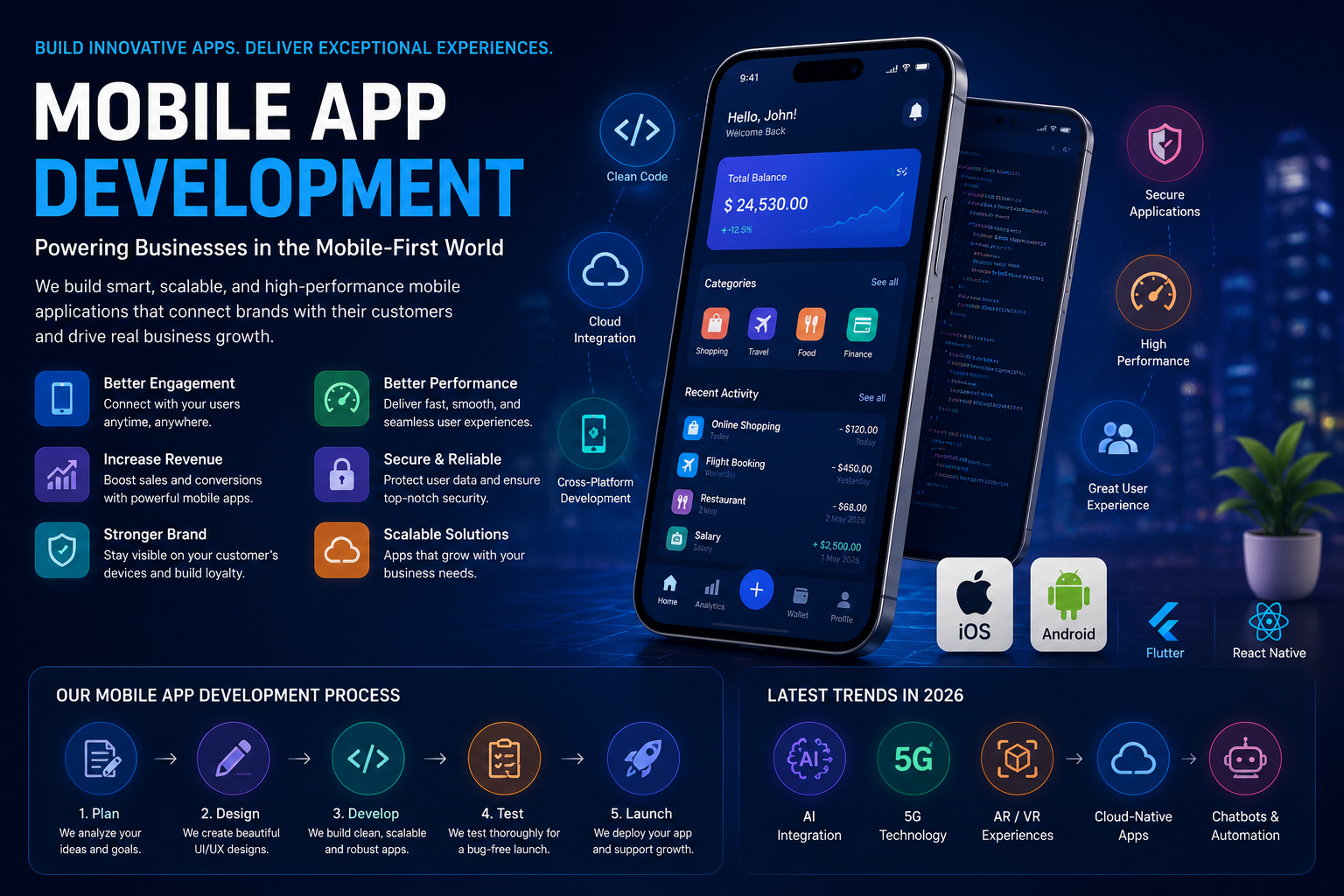
Mobile App Development in 2026: Why Every Business Needs a Mobile App
Mobile app development has become one of the most important investments for businesses in 2026. With billions of smartphone users worldwide, mobile applications are now essential for improving customer engagement, increasing sales, streamlining operations, and building brand loyalty.
From startups and ecommerce stores to healthcare providers and enterprise organizations, businesses across every industry are using mobile apps to stay competitive in an increasingly digital marketplace.
In this guide, we’ll explore what mobile app development involves, the benefits of having a mobile app, the latest development trends, and how businesses can choose the right mobile app development strategy.
What Is Mobile App Development?
Mobile app development is the process of creating software applications that run on smartphones and tablets.
These apps are typically developed for:
iOS devices (Apple iPhone and iPad)
Android devices
Cross-platform frameworks
Mobile applications can serve many purposes, including:
Ecommerce
Customer support
Online booking
Food delivery
Social networking
Healthcare services
Business management
Education and eLearning
Entertainment and gaming
Modern mobile apps are designed to provide fast, convenient, and personalized user experiences.
Why Mobile Apps Are Important for Businesses
Consumers spend more time on mobile devices than ever before. Businesses that fail to invest in mobile technology risk losing customers to competitors offering better digital experiences.
1. Improved Customer Engagement
Mobile apps provide direct communication between businesses and customers.
Features like:
Push notifications
In-app messaging
Personalized offers
Loyalty programs
help businesses stay connected with users in real time.
Unlike websites, mobile apps allow businesses to engage customers instantly and more effectively.
2. Better User Experience
Mobile apps are faster and more responsive than traditional websites.
Apps can provide:
Smooth navigation
Faster loading times
Offline functionality
Personalized experiences
Simplified checkout processes
A well-designed mobile app improves customer satisfaction and increases retention.
3. Increased Sales and Revenue
Mobile commerce continues to grow rapidly in 2026.
Businesses use mobile apps to:
Sell products online
Accept payments
Offer subscriptions
Promote special deals
Increase repeat purchases
Features like one-click checkout and mobile wallets make purchasing easier for customers.
4. Stronger Brand Visibility
A mobile app keeps your business visible on customers’ devices every day.
Frequent interaction with your app helps strengthen:
Brand awareness
Customer loyalty
User trust
Long-term engagement
Businesses with professional mobile apps often appear more modern and credible.
Types of Mobile Apps
Native Mobile Apps
Native apps are built specifically for one platform, such as iOS or Android.
Benefits include:
Faster performance
Better security
Full access to device features
Improved user experience
Popular technologies include:
Swift for iOS
Kotlin for Android
Cross-Platform Apps
Cross-platform apps use a single codebase for multiple platforms.
Popular frameworks include:
Flutter
React Native
Xamarin
Benefits include:
Faster development
Lower costs
Easier maintenance
Cross-platform development is becoming increasingly popular for startups and small businesses.
Progressive Web Apps (PWAs)
PWAs combine features of websites and mobile apps.
They offer:
Fast loading
Offline support
Mobile-friendly experiences
Lower development costs
Many businesses use PWAs as an alternative to fully native apps.
The Mobile App Development Process
1. Planning and Strategy
Every successful app starts with a clear strategy.
This includes:
Identifying business goals
Defining target users
Researching competitors
Planning app features
Creating a monetization model
Careful planning reduces development risks and improves project success.
2. UI/UX Design
User experience is critical in mobile app development.
Professional app designers focus on:
Easy navigation
Clean layouts
Mobile responsiveness
Accessibility
Fast interactions
A strong UI/UX design improves user satisfaction and retention rates.
3. App Development
Developers build the frontend and backend systems powering the app.
This may include:
APIs
Databases
Payment systems
Authentication
Cloud services
Modern mobile apps often integrate AI, automation, and real-time analytics.
4. Testing and Quality Assurance
Before launch, apps undergo extensive testing to identify bugs and performance issues.
Testing includes:
Device compatibility
Security testing
Performance optimization
User testing
Functional testing
A stable app improves user reviews and app store rankings.
5. Launch and Maintenance
After deployment to the Apple App Store and Google Play Store, ongoing maintenance is essential.
This includes:
Security updates
Performance improvements
New features
Bug fixes
Compatibility updates
Continuous updates help apps remain competitive.
Latest Mobile App Development Trends in 2026
AI-Powered Mobile Apps
Artificial intelligence is transforming mobile applications.
AI features now include:
Chatbots
Voice assistants
Personalized recommendations
Predictive analytics
AI image generation
Smart automation
AI-powered experiences improve customer engagement and efficiency.
Cloud-Based Mobile Apps
Cloud integration allows apps to:
Sync data across devices
Improve scalability
Reduce infrastructure costs
Support remote access
Cloud-native apps are becoming the standard for modern businesses.
5G Technology
5G networks are enabling:
Faster app performance
Real-time streaming
Advanced gaming
AR and VR experiences
Improved IoT connectivity
Developers are building apps optimized for ultra-fast mobile connectivity.
Augmented Reality (AR) and Virtual Reality (VR)
AR and VR are increasingly used in:
Ecommerce
Education
Healthcare
Real estate
Gaming
Interactive experiences help businesses improve engagement and customer experience.
How to Choose a Mobile App Development Company
Choosing the right development partner is critical for project success.
Look for a company with:
Proven app development experience
Strong portfolio
UI/UX expertise
Transparent pricing
Good client reviews
Post-launch support
Knowledge of modern technologies
It’s also important to choose developers who understand your business goals and target audience.
Benefits of Professional Mobile App Development
Working with professional developers ensures:
Better app performance
Stronger security
Faster development
Scalable architecture
Improved app store optimization (ASO)
Long-term technical support
Professional development reduces costly mistakes and improves overall app quality.
Final Thoughts
Mobile app development is no longer optional for businesses that want to compete in today’s digital economy.
A high-quality mobile app can help businesses:
Increase customer engagement
Improve brand loyalty
Generate more revenue
Streamline operations
Deliver better customer experiences
As mobile technology, AI, and cloud computing continue evolving, businesses that invest in mobile app development in 2026 will be better positioned for long-term growth and success.
Whether you’re launching a startup app, ecommerce platform, or enterprise solution, investing in professional mobile app development can transform the way your business connects with customers.