
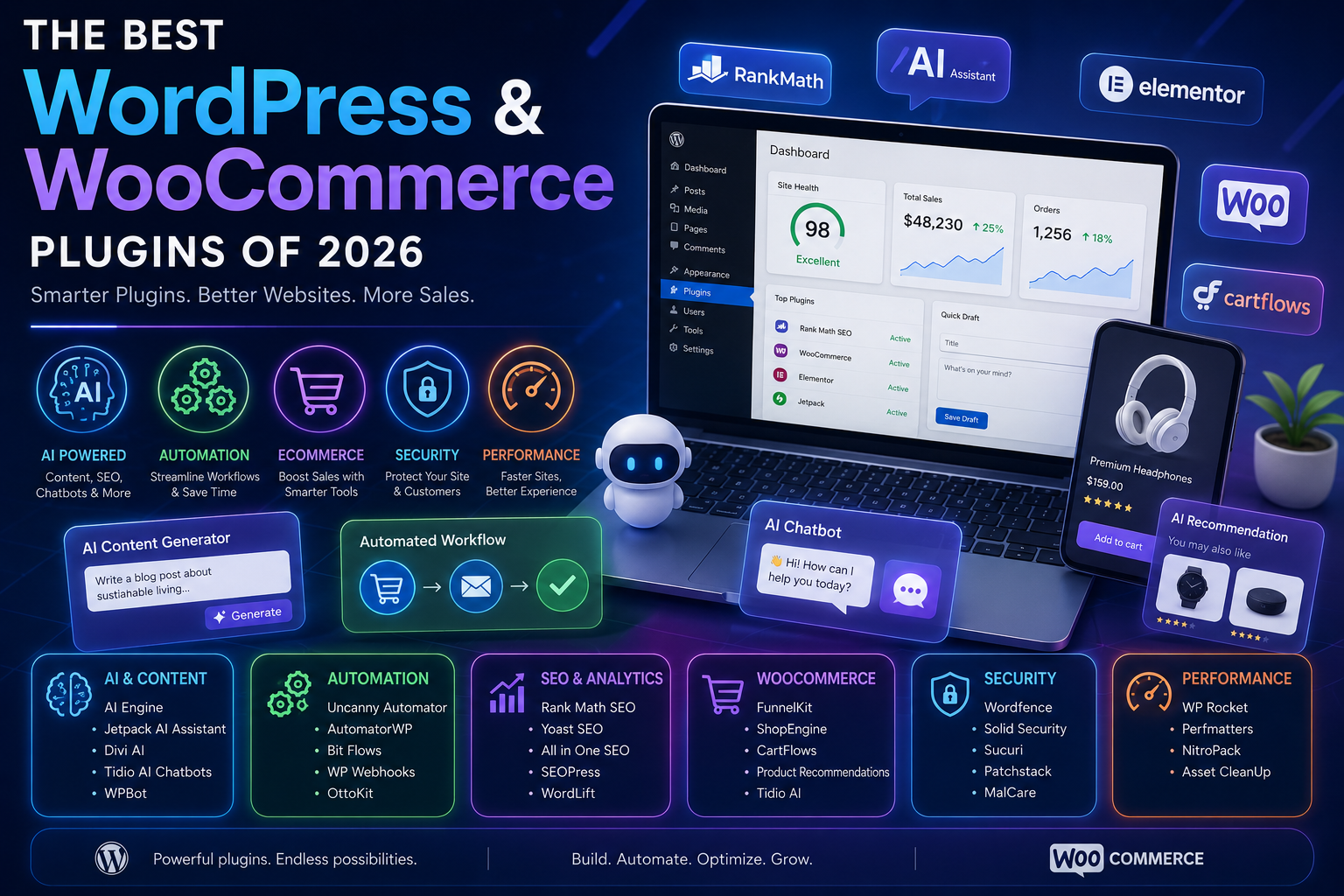
The Best WordPress and WooCommerce Plugins of 2026
WordPress and WooCommerce are evolving faster than ever in 2026. The biggest shift this year is the rise of AI-powered automation, intelligent personalization, and workflow orchestration directly inside WordPress dashboards.
Website owners are no longer just installing plugins for SEO or forms — they’re building fully automated ecosystems that handle content creation, marketing, customer support, analytics, and sales with minimal manual work.
Here are the most important WordPress and WooCommerce plugins dominating 2026.
1. AI Engine — The Rise of AI-Native WordPress
One of the biggest plugin categories in 2026 is AI integration.
Plugins like AI Engine, Jetpack AI Assistant, and Divi AI are transforming WordPress into an intelligent publishing platform capable of:
AI content generation
AI image creation
Automated SEO optimization
Chatbot support
Smart workflows
AI-assisted design
According to multiple WordPress industry reports, AI plugins are now among the fastest-growing plugin categories in the ecosystem. (Elementor)
Popular AI-focused plugins include:
AI Engine
Jetpack AI Assistant
Divi AI
Tidio AI Chatbots
WPBot
Jotform AI Chatbot
Jetpack AI Assistant has become especially popular because it works directly inside the Gutenberg editor, allowing creators to generate articles, lists, translations, and featured images without leaving WordPress. (Purethemes)
2. Uncanny Automator — WordPress Automation Goes Mainstream
Automation plugins are exploding in popularity in 2026.
Instead of manually connecting services, WordPress users are building no-code workflows that automate:
Customer emails
WooCommerce orders
CRM syncing
Social media posting
Course enrollments
Membership management
Among the leaders is Uncanny Automator, which connects over 200 WordPress plugins and external services through trigger-based automations. (Bit Integrations)
Other major automation plugins include:
AutomatorWP
Bit Integrations
WP Webhooks
Bit Flows
OttoKit
Bit Flows has gained attention for embedding AI agents directly into workflow automation, allowing WordPress sites to perform intelligent decision-making and content generation inside automated pipelines. (Bit Integrations)
This is turning WordPress from a traditional CMS into an automation platform.
3. Rank Math and AI SEO Optimization
SEO plugins are becoming AI-driven growth engines.
Rank Math continues to dominate the WordPress SEO ecosystem in 2026 thanks to:
AI-generated metadata
Predictive keyword suggestions
Automated schema markup
Internal linking recommendations
AI content scoring
AI-powered SEO optimization is now a core requirement for content publishers trying to compete in increasingly crowded search environments. (Jotform)
Other major SEO plugins in 2026 include:
Yoast SEO
All in One SEO
SEOPress
WordLift
WordLift is especially interesting because it uses structured AI-driven semantic SEO to help search engines better understand website content.
4. WooCommerce AI Plugins Are Changing Ecommerce
WooCommerce plugins in 2026 are heavily focused on AI-powered selling and personalization.
The latest WooCommerce AI plugins now offer:
Predictive product recommendations
AI customer support
Smart upselling
Automated abandoned cart recovery
Personalized shopping journeys
AI-generated product descriptions
Industry reports show store owners increasingly adopting AI plugins to improve conversion rates and reduce operational workload. (WBW)
Popular WooCommerce plugins in 2026 include:
FunnelKit
ShopEngine
CartFlows
Product Recommendations for WooCommerce
Tidio AI
Qualimero AI Consultation
Qualimero’s guided AI shopping assistant is one of the most talked-about ecommerce tools this year because it acts like an in-store sales advisor directly inside WooCommerce stores. (Qualimero)
5. Security Plugins Are Becoming AI-Powered
Security remains one of the biggest concerns in WordPress.
With plugin vulnerabilities increasing across the ecosystem, security plugins are evolving rapidly. (The Verge)
Leading security plugins in 2026 include:
Wordfence
Solid Security
Sucuri
Patchstack
MalCare
Modern security plugins now include:
AI threat detection
Automated malware cleanup
Real-time vulnerability monitoring
Bot protection
Behavioral analysis
Patchstack has become especially important for monitoring plugin vulnerabilities across large WordPress installations.
6. Elementor and Divi Continue the Builder Wars
The page-builder competition remains intense.
Elementor continues to dominate visual WordPress design, while Divi is aggressively integrating AI tools directly into its builder ecosystem.
Key 2026 features include:
AI layout generation
Automated responsive design
AI-generated copywriting
Dynamic content personalization
AI image generation
Elementor’s AI ecosystem is expanding rapidly, with many users now building entire websites through conversational prompts. (Elementor)
Meanwhile, Gutenberg itself continues improving with WordPress collaboration and workflow upgrades expected in WordPress 6.9 and beyond. (DEV Community)
7. AI Chatbots Are Now Essential for Websites
Customer support plugins are no longer optional.
AI chatbots are becoming standard on WordPress and WooCommerce websites because they:
Reduce support costs
Increase conversions
Improve lead generation
Provide 24/7 customer assistance
Top chatbot plugins include:
Tidio AI
Jotform AI Chatbot
WPBot
BetterDocs AI
Crisp AI
Tidio’s AI chatbot “Lyro” has become particularly popular among ecommerce stores because it automates FAQs, pre-sale support, and customer service workflows. (CS Web Solutions)
8. The Future of WordPress Plugins Is AI Agents
The biggest trend of 2026 is the emergence of AI agents inside WordPress.
Instead of simple plugins performing isolated tasks, AI agents can now:
Manage workflows
Generate content
Analyze customer behavior
Recommend products
Automate marketing campaigns
Coordinate multiple plugins together
Some industry observers believe this could fundamentally change how websites are managed. (Blocksy)
At the same time, new AI-native CMS platforms like EmDash are beginning to challenge WordPress by building AI functionality directly into the core architecture. (The Verge)
This pressure is pushing WordPress toward deeper AI integration faster than ever before.
Final Thoughts
The WordPress and WooCommerce ecosystem in 2026 looks dramatically different from just a few years ago.
The most successful plugins are no longer simple add-ons — they are intelligent systems capable of:
Automation
Personalization
AI-powered workflows
Predictive analytics
Autonomous customer interaction
For website owners, ecommerce brands, bloggers, and developers, the message is clear:
AI-powered plugins are rapidly becoming essential infrastructure for modern WordPress websites.
And by the end of 2026, fully autonomous AI-managed WordPress sites may no longer sound futuristic at all.